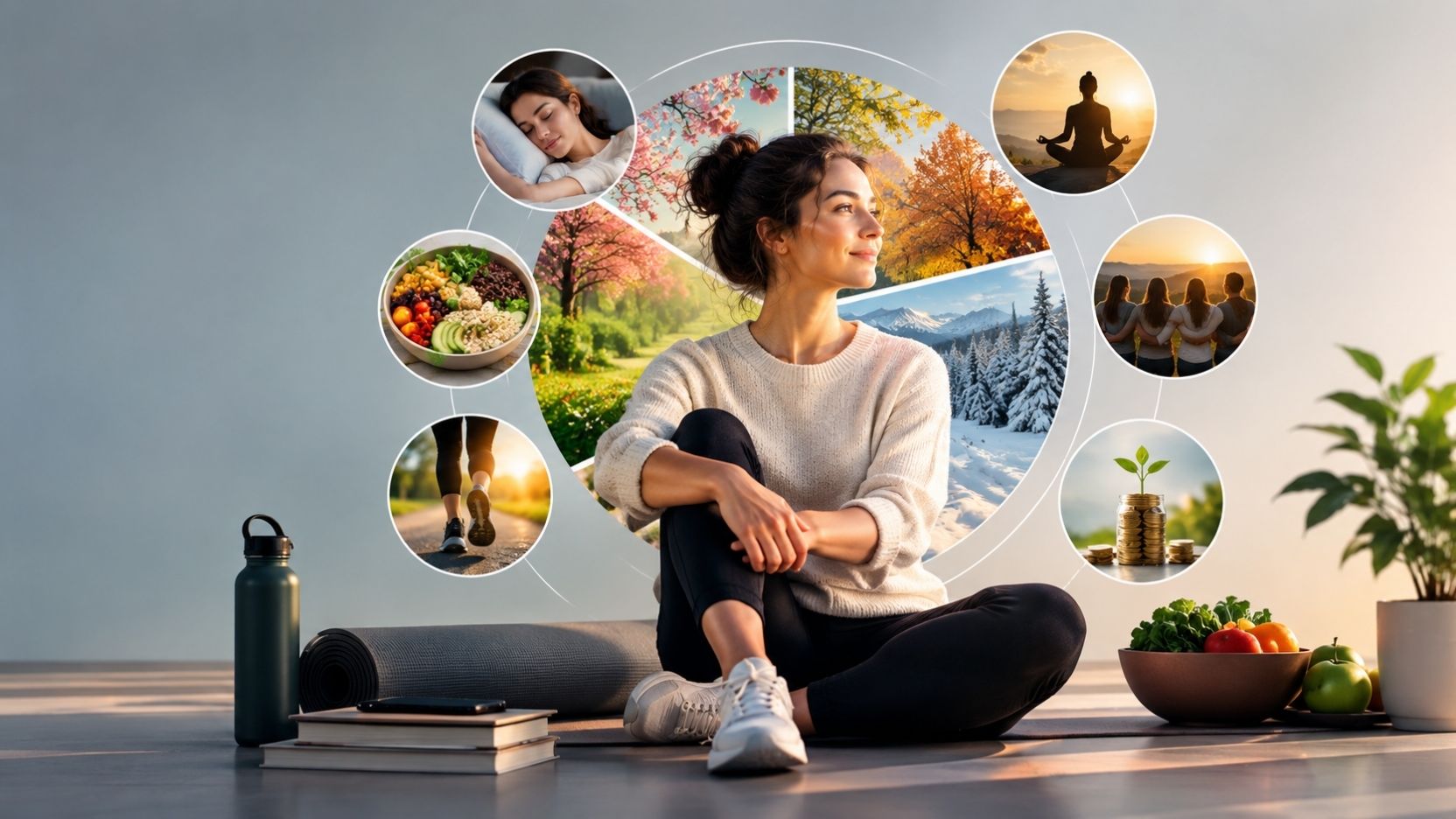

Environmental wellness means living, working, and learning in surroundings that are safe, pleasant, and supportive of your health. It also means recognizing how your own choices affect those surroundings. SAMHSA lists it as one of eight dimensions of wellness, alongside emotional, physical, social, and financial health. This guide explains the definition, the evidence behind it, and practical examples.
If you searched for this term, you may be a student with an assignment. You may be a health professional who needs a clean definition. Or you may just want to know what it means for your own home and habits. This article is written for all three.
Key takeaways
- Environmental wellness is one of eight dimensions in the SAMHSA wellness model.
- It covers your home, workplace, school, neighborhood, and the natural world.
- It works in two directions: how surroundings affect you, and how you affect them.
- Small actions count, such as improving ventilation, checking air quality, or spending time outdoors.
What Does Environmental Wellness Mean in Plain Language?
Environmental wellness is about the places you spend your time and how well they support you. A good environment helps you feel safe, calm, and healthy. A poor one can wear you down slowly, often without you noticing.
It also works in both directions. Your surroundings shape your health, and your habits shape your surroundings. Most definitions include both halves.
Can You Define It in One Sentence?
Yes. Environmental wellness is the practice of keeping your surroundings safe, healthy, and pleasant while respecting the natural world you share with others.
That sentence is a plain summary drawn from the official definitions below. It is not a direct quote from any agency.
How SAMHSA Defines Environmental Wellness
SAMHSA’s wellness poster describes the environmental dimension as good health that comes from spending time in pleasant, stimulating surroundings that support wellbeing. That is the shortest official wording you will find.
The agency’s step by step guide adds another idea: being safe and feeling safe. It also notes that a clean, safe living space helps people feel organized and in control.
Universities that teach the SAMHSA model often expand it. One example stresses respect for nature, awareness of how your interactions affect the environment, and protection from environmental pollutants.
The framework was built with a specific audience in mind. SAMHSA encourages individuals, organizations, and communities to pursue longer, healthier, happier lives, particularly among people living with behavioral health conditions. The model is now used far more widely than that.
How NIH Describes It
The NIH Environmental Wellness Toolkit focuses on what surrounds you at home, at work, and in your neighborhood, along with the resources available to you. It admits you cannot always choose your surroundings, but says small steps can make them safer and limit contact with harmful substances.
Earlier wording tells a slightly different story. One health site reproducing older NIH language framed the idea as recognizing your own responsibility for the quality of your surroundings. Ohio State’s teaching wellness toolkit uses similar language about responsibility to improve, protect, or preserve quality of life in a community.
So the sources lean in different directions. SAMHSA stresses how surroundings support you. NIH stresses safety and exposure. Others stress personal responsibility. A complete definition holds all three ideas.
See More: Personal Wellness
Where Did the Environmental Dimension Come From?
The idea grew out of the wellness movement, and it was not part of the earliest models. Physician Halbert Dunn introduced high level wellness in 1959, describing an integrated way of functioning aimed at reaching one’s potential. He is often called the father of the wellness movement.
Bill Hettler later proposed a six dimension model in the 1970s, designed for students at the University of Wisconsin Stevens Point. The National Wellness Institute still promotes those six: emotional, occupational, physical, social, intellectual, and spiritual. Environmental wellness is not among them.
| Milestone | Who or what | What it added |
| 1959 | Halbert Dunn | High level wellness as more than absence of illness |
| 1970s | Bill Hettler | Six dimensions, later adopted by the National Wellness Institute |
| 2006 | Margaret Swarbrick | A wellness approach that SAMHSA’s graphics adapt |
| Later | SAMHSA | Eight dimensions, adding environmental and financial |
SAMHSA’s eight dimension version adds environmental and financial wellness to Hettler’s six. Its materials credit an adaptation of Swarbrick’s 2006 article on a wellness approach. Other authors have also added cultural, economic, and climate dimensions.
Because models differ, definitions differ. That is why two websites can describe environmental wellness a little differently and both be reasonable.
Is Environmental Wellness the Same as Environmental Health?
No, but they are close relatives. Environmental health is a public health field. Environmental wellness is a personal wellbeing concept that borrows from it.
The World Health Organization describes environmental health as the physical, chemical, and biological factors external to a person, plus related factors that affect behavior. Its definition excludes behavior tied to the social and cultural environment, and genetics.
Healthy People 2030 explains that environmental health is about how the environment affects human health and wellbeing, through pollution and through larger environmental disturbances.
| Aspect | Environmental Health | Environmental Wellness |
| Main focus | External physical, chemical, and biological factors | Your wellbeing in your surroundings and your role in protecting them |
| Guiding question | What hazards exist and how do we control them? | How can my surroundings support me, and how can I support them? |
| Scope | A public health field with a defined scope | One dimension within a wider wellness model |
| Example | Monitoring a community water supply | Testing your own well or conserving water at home |
Some researchers argue that public health should treat the environment as a health resource, not only a source of risk. They describe this as building health promoting spaces. Environmental wellness fits that resource view well.
What Counts as Your Environment?
The word “environment” is broader than most people expect. It is not only forests and oceans. It includes the rooms you sleep and work in, the air inside them, and the streets outside.
Your Home, Workplace, and School
NIEHS describes built environments as places such as homes, schools, workplaces, places of worship, and gyms. These are the spaces where most of your hours go.
Rocky Mountain University’s summary says these areas should be pleasant and support your wellbeing. That includes temperature, air, light, noise, and layout.
The Natural World
The natural environment includes air, water, and soil, while the built environment also covers roads, land use, and waste management. You interact with all of it daily, even in a city.
This is also where your impact comes in. Recycling, conserving water, and reducing waste are part of the definition, not extras.
Safety and Atmosphere
Environment is not only physical. One wellness article notes it can be hard to feel good when you are surrounded by clutter and disorganization, or when you feel unsafe. It lists pollution, violence, garbage buildup, and water conservation among the factors.
That social side is where wellness goes beyond the WHO’s public health definition. Feeling safe is part of the concept.
| Component | What it covers | Everyday example |
| Indoor air | Pollutants, moisture, and ventilation inside buildings | Running the bathroom fan after a shower |
| Outdoor air | Ozone, particle pollution, and wildfire smoke | Checking the daily air quality forecast |
| Water | Drinking water and recreational water safety | Testing a private well |
| Noise | Traffic, machinery, and constant loud sound | Choosing a quieter room for sleep |
| Nature | Parks, trails, gardens, and green space | A weekly walk in a nearby park |
| Safety and order | Feeling secure, uncluttered, and in control | Fixing hazards and clearing a workspace |
| Weather | Heat, cold, and seasonal hazards | Keeping a home warm enough in winter |
| Waste and resources | Recycling, energy use, and water conservation | Switching to energy efficient bulbs |
Why Does Environmental Wellness Matter for Your Health?
The short answer is exposure. You breathe, drink, hear, and touch your environment every hour of every day. Small problems add up.
You Spend Most of Your Time Indoors
The EPA says Americans spend about 90 percent of their time indoors, where some pollutants are often two to five times higher than typical outdoor levels.
The people most vulnerable to pollution, such as the very young, older adults, and those with heart or lung disease, tend to spend even more time inside. NIEHS notes that indoor air pollution can contribute to respiratory disease, heart disease, cognitive problems, and cancer.
Radon shows how invisible a hazard can be. It is a colorless, odorless gas that enters through cracks in buildings, and the EPA estimates it causes about 21,000 lung cancer deaths in the U.S. each year. You cannot detect it without testing.
The problem is even larger globally. The World Health Organization estimates that 3.8 million people die each year from illness linked to harmful indoor air from dirty cookstoves and fuels.
The Air Outside Is a Bigger Issue Than Many People Realize
The American Lung Association’s State of the Air 2026 report found that 152.3 million people, or 44 percent of Americans, live in places with failing grades for ozone or particle pollution. The report evaluated official monitoring data from 2022 to 2024.
Children are especially exposed. About 46 percent of American children, or 33.5 million, live in counties with at least one failing grade, and their still developing lungs make them more vulnerable.
The burden is not spread evenly. Dr. Afif El-Hasan, a pulmonologist and association spokesperson, noted that many high pollution areas are also places with fewer socioeconomic resources. That is a reminder that environmental wellness is not only a matter of personal choice.
Noise Is a Stressor, Not Just an Annoyance
Many people treat noise as a nuisance. Health agencies treat it as an exposure. CDC lists effects of excessive environmental sound that reach beyond hearing, including the cardiovascular system, sleep, cognition, and mental health.
The EPA determined in 1974 that a 24 hour average of 70 decibels would produce minimal hearing loss in 96 percent of the population. OSHA requires employers to run a hearing conservation program when workers average 85 decibels over eight hours.
Stress is a separate issue from hearing damage. UCLA Health explains that your body’s stress response can kick in at any level of chronic noise, and raised blood pressure is the most common cardiovascular effect. Constant traffic hum can matter even if it never feels loud.
Time in Nature Is Linked to Better Health
The best known finding comes from England. A University of Exeter led study found that people who spent at least 120 minutes a week in nature were significantly more likely to report good health and higher psychological wellbeing than those who spent no time there.
It used data from nearly 20,000 people, and it did not matter whether the time came from one long visit or several shorter ones. Associations peaked at around 200 to 300 minutes a week, with no further gain beyond that.
There is an important caution. The authors said more longitudinal and experimental studies are needed before firm conclusions, and their exposure measure left out time in a person’s own garden. Treat 120 minutes as a helpful target, not a medical prescription.
How Your Surroundings Touch Every Other Dimension
Environmental wellness rarely stands alone. Noise disrupts sleep, which affects physical and emotional health. A cluttered or unsafe space raises stress, which affects relationships and focus.
Work and study settings show the link clearly. A 2022 review cited by Ohio State’s teaching wellness toolkit reports that better physical spaces can reduce poor attention, absenteeism, and stress, while raising cognitive performance. Your desk, classroom, and commute belong in this conversation.
Money matters too. Keeping a home safely warm costs money, so financial and environmental wellness overlap. NIH points readers who struggle with heating bills to a federal energy assistance program.
See More: 10 Dimensions Of Wellness
What Are Some Real Examples of Environmental Wellness?
Examples make the concept concrete. The ones below come from NIH and SAMHSA guidance, plus common sense adaptations.
At Home
NIH’s healthier home checklist includes these actions:
- Vacuum regularly, ideally with a HEPA filter, and wipe surfaces with a damp cloth.
- Leave shoes at the door so pesticides and dirt stay outside.
- Fix leaks, dry wet areas quickly, and clean mold.
- Open windows when possible and use kitchen and bathroom exhaust fans.
- Choose fragrance free soaps and cleaners with fewer added chemicals.
- Test private well water regularly and use a certified filter if contaminants appear.
The toolkit also advises testing exposed paint for lead if your home was built before 1978, and testing for radon. Some city health departments and local programs offer free test kits.
At Work or School
You often cannot redesign a workplace. You can still notice what helps and what hurts. Ventilation, noise levels, seating, and clutter all influence how you feel by mid afternoon.
Ohio State’s guidance suggests rethinking classroom layout to improve student engagement in active learning. It also stresses safety and security in every setting, including online, on campus, and in clinical settings.
Simple workplace actions include:
- Reporting leaks, mold smells, or stale air to facilities staff.
- Keeping your workspace tidy enough to think in.
- Taking breaks outdoors when you can.
- Asking whether the building has a ventilation maintenance plan.
Outdoors and in Your Community
SAMHSA guidance quoted by a state health site suggests recycling whenever possible, buying recycled products, and joining cleanup efforts such as collecting trash along roads or parks. It also suggests energy efficient bulbs and finding outdoor activities that make you feel good, such as a walk in a public park.
None of this requires activism. Rocky Mountain University’s page notes that environmental wellness does not require joining a movement. Consistent, ordinary habits are enough.
During Extreme Weather and Bad Air Days
Weather is part of your environment, and it can be dangerous. NIH advises outdoor activity during the coolest part of the day in hot weather, plus protective clothing, shade, and plenty of water.
For cold weather, it advises keeping your home heat at 68 degrees Fahrenheit or higher, dressing in layers, and getting fast medical help for signs of hypothermia.
For air quality, NIH recommends checking daily forecasts at AirNow.gov, limiting outdoor activity when pollution is high, and keeping windows closed during wildfire smoke events.
How Does It Fit Among the Eight Dimensions of Wellness?
Environmental wellness is one piece of a larger picture. The table below summarizes all eight dimensions in SAMHSA’s model. It also covers the financial, occupational, and spiritual definitions that people often search for alongside this one.
| Dimension | What SAMHSA emphasizes |
| Emotional | Coping effectively with life and creating satisfying relationships |
| Financial | Satisfaction with your current and future financial situation |
| Social | A sense of connection, belonging, and a well developed support system |
| Spiritual | Expanding your sense of purpose and meaning in life |
| Occupational | Personal satisfaction and enrichment from your work |
| Physical | Recognizing the need for physical activity, healthy diet, sleep, and nutrition |
| Intellectual | Recognizing creative abilities and finding ways to grow knowledge and skills |
| Environmental | Good health from pleasant, stimulating surroundings that support wellbeing |
SAMHSA says each dimension can affect overall quality of life, and that the model looks beyond physical health to all the factors behind wellness. The dimensions overlap constantly. A quiet, safe home supports emotional wellness. A healthy workplace supports occupational wellness.
How Can You Start Improving It This Week?
You do not need a full home renovation. Start with a few small steps and build from there.
- Check the air quality forecast. AirNow.gov provides daily forecasts. Make it a habit on hot or smoky days.
- Improve ventilation. Use exhaust fans when cooking, especially with gas stoves, and change HVAC filters about every three months.
- Walk through your home once. Look for leaks, damp patches, and mold. Fix small problems before they grow.
- Plan your outdoor time. Aim toward the 120 minute weekly range from the Exeter study. Several short visits count.
- Test for hidden hazards. Ask your local health department about radon and lead test kits, and test well water if you use it.
- Cut one source of noise or clutter. Move your sleep space away from noise if you can, and clear one workspace.
- Add one community habit. Start recycling, or join a park cleanup this month.
Pick two or three, not all seven. Consistency matters more than ambition.
What If You Cannot Control Your Surroundings?
Many people cannot. Renters depend on landlords, employees depend on employers, and some neighborhoods carry heavier pollution.
NIH acknowledges that you cannot always choose the environments you live, work, or play in. The goal is to do what is in reach without blaming yourself for what is not.
Here are practical options:
- Use free public resources. Local programs may provide free radon and lead test kits, and a federal program helps some households pay heating bills.
- Talk to a professional. NIH suggests asking your doctor how air pollution at home, school, or work may affect your health.
- Report problems. Tell your landlord, facilities team, or local health department about mold, leaks, or unsafe conditions.
- Focus on the controllable. Even a single room with better air or less noise can help.
Community action can matter more than any personal habit. That is part of why the definition includes community wellbeing, not just individual comfort.
How Strong Is the Evidence Behind All This?
It depends on the claim. Some findings are firm. EPA figures on indoor time and pollutant levels and the American Lung Association’s monitoring based grades rest on official measurement data.
Other findings are associations. The nature study relied on self reported health and self reported visits. It shows a pattern, not proof that nature time causes better health.
Definitions also vary by source. SAMHSA, NIH, and universities each phrase the concept differently. That is normal for a framework, but it means you should cite the specific source you are using.
Finally, wellness guidance is educational. It does not replace medical advice, especially if you have asthma, heart disease, allergies, or another condition that makes environmental exposures riskier.
See More: Wellness Synonym
What Is the Main Thing to Remember?
Environmental wellness means having surroundings that support your health, and caring for them in return. That covers indoor and outdoor air, water, noise, safety, nature, and the daily habits that shape all of them.
The strongest evidence points to a few simple priorities: cleaner indoor air, awareness of outdoor air quality, less chronic noise, and regular time outside. Start small, use free resources, and remember that some barriers are not yours to fix alone.
Questions People Also Ask About Environmental Wellness
What is environmental wellness in simple terms?
It is the part of your health tied to your surroundings. It covers whether your home, workplace, and neighborhood feel safe and healthy, and how your habits affect the natural world. Think of it as a two sided relationship between you and where you live.
What is the SAMHSA definition of environmental wellness?
SAMHSA describes it as good health that comes from occupying pleasant, stimulating environments that support wellbeing. Its guide adds that it involves being safe and feeling safe.
What is a short definition of environmental wellness?
Environmental wellness is keeping your surroundings safe and healthy while respecting the natural world. It includes where you live, work, and learn, plus how your choices affect the planet and your community.
What are examples of environmental wellness?
Testing your home for radon, using exhaust fans, checking air quality forecasts, recycling, spending time in a park, and keeping your workspace safe are all examples. NIH also lists preventing mold and reducing dust.
Why is environmental wellness important?
Your surroundings affect your air, sleep, stress, and safety every day. Americans spend about 90 percent of their time indoors, where some pollutants can run higher than outdoors. Poor surroundings can quietly affect physical and emotional health.
What is the difference between environmental health and environmental wellness?
Environmental health is a public health field focused on external physical, chemical, and biological factors. Environmental wellness is a personal dimension of overall wellbeing. It adds ideas like feeling safe, enjoying pleasant surroundings, and taking responsibility for your own impact.
What are the eight dimensions of wellness?
SAMHSA’s eight dimensions are social, environmental, physical, emotional, spiritual, occupational, intellectual, and financial. Each affects quality of life, and they overlap in everyday situations.
How do financial, occupational, and spiritual wellness differ?
Financial wellness is satisfaction with your current and future finances. Occupational wellness is personal satisfaction from your work. Spiritual wellness is expanding your sense of purpose and meaning. Each is separate, though they influence one another.
Is there a Wikipedia page for environmental wellness?
A dedicated Wikipedia article did not turn up in my research. The closest match is the page on environmental health. It quotes the WHO definition covering physical, chemical, and biological factors external to a person. For wellness itself, SAMHSA and NIH are stronger sources.
Where can I find an environmental wellness PDF?
The SAMHSA Library offers its step by step wellness guide, which covers all eight dimensions and includes tips for each. NIH also offers a printer friendly version of its Environmental Wellness Toolkit.
How much time in nature is enough?
One large English study linked at least 120 minutes a week in nature with better self reported health and wellbeing. It is an association, not a guarantee. Several short visits appeared to work as well as one long one.
Does environmental wellness affect mental health?
Yes, in several ways. Chronic noise can trigger stress responses, and feeling unsafe or surrounded by clutter can make it hard to feel good. Time in nature is also linked with better reported wellbeing.
Can renters improve their environmental wellness?
Yes. Renters can leave shoes at the door, use exhaust fans, keep humidity down, and report leaks or mold. Local programs may also provide free radon and lead test kits. Not every change needs permission.