
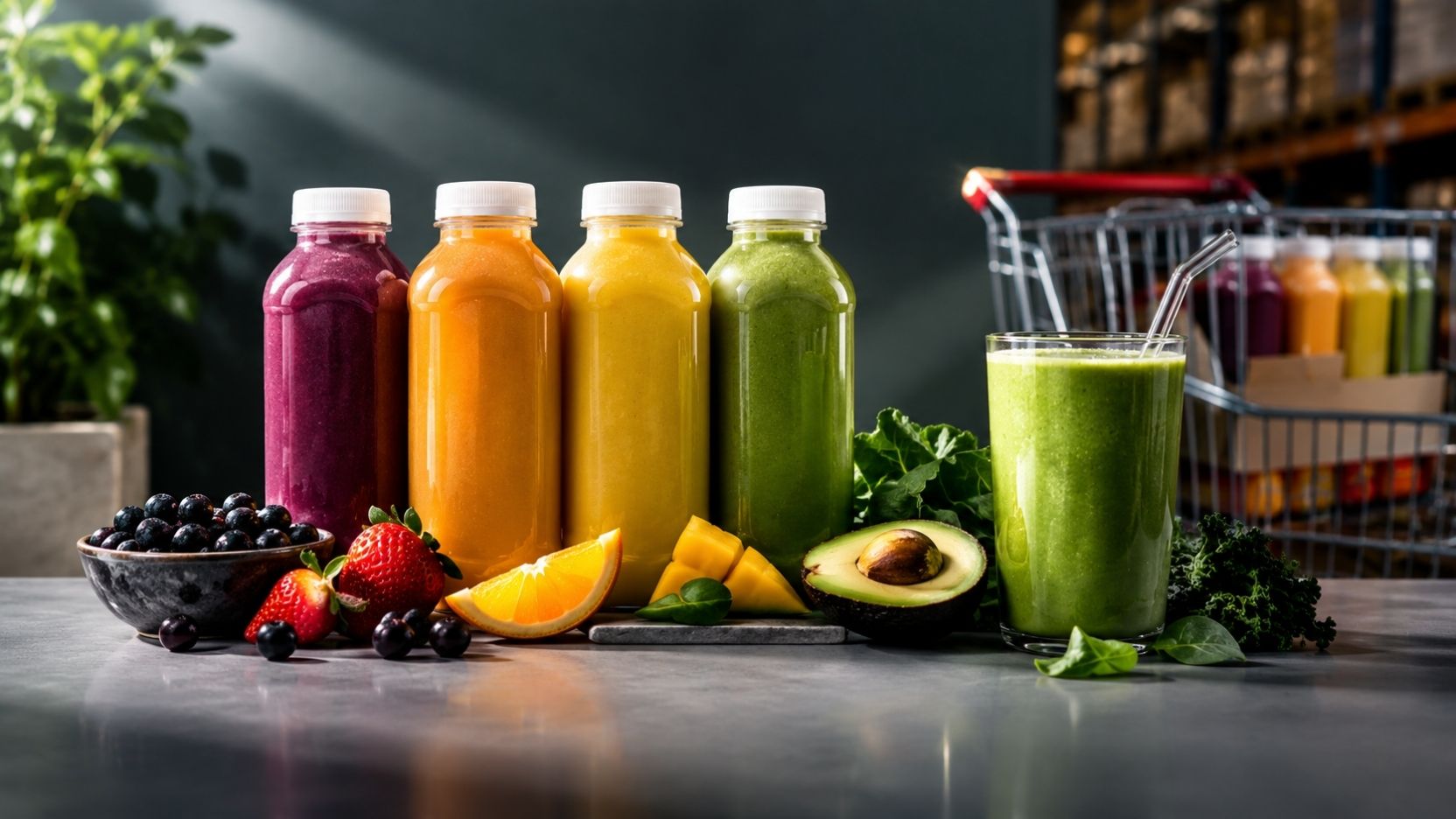
A wellness smoothie is a blended drink sold for everyday health, usually made from fruit, greens, and added nutrients. Most people searching the term mean the Pressed Juicery Wellness Smoothie sold in an eight pack at Costco. It is cold pressed, labeled with no added sugar, and comes in four flavors. It is also a fruit and juice drink, so the natural sugar adds up.
This guide covers what is inside each bottle, the calories, the price, and what reviewers say. It also sorts out other products with similar names. Those include the Playa Bowls Wellness Wave Smoothie, Heal Wellness bowls, Fit & Wellness smoothie packs, and the Wellness Garden 10 Day Green Smoothie.
The Short Version
- Pressed Juicery’s Costco pack holds eight 10 oz bottles. You get two each of Acai Berry, Strawberry Orange Mango, Tropical, and Avocado Greens.
- The pack launched nationwide in July 2025 at $16.89, or about $2.11 a bottle. Your warehouse price may differ today.
- The label says no added sugar. Public nutrition databases still list about 22 to 32 grams of sugar per bottle, all from fruit and juice.
- A bottle can help you eat more fruit and greens. Federal guidance still prefers whole fruit over juice.
- Several unrelated products share the wellness smoothie name. Check which one you actually mean.
See More: Environmental Wellness Examples
Which Wellness Smoothie Are You Looking For?
Wellness smoothie is not one product. Search results mix a bottled drink, made to order cafe items, a frozen mix, and a powder. This table separates them.
| Name | What it is | Where it appears | Format |
| Pressed Juicery Wellness Smoothie | Cold pressed fruit smoothie from a California juice brand | Costco, Pressed’s website, grocery and club retailers | Bottled, refrigerated |
| Wellness Wave Smoothie | Kale, pineapple, banana, and protein smoothie | Playa Bowls shops | Made to order |
| Heal Wellness | Acai and smoothie bowl shop | Listings in Ontario, Quebec, and Prince Edward Island | Made to order bowls and smoothies |
| Fit & Wellness | Frozen fruit and veggie smoothie mix from Campoverde | A Walmart listing | Frozen packs |
| Wellness Garden 10 Day Green Smoothie | Powdered green drink mix sold as a supplement | Online marketplaces | Powder scoops |
The rest of this guide focuses on Pressed Juicery. Most Costco, ingredient, and review searches lead there. The lookalikes get their own section later.
What Is the Pressed Juicery Wellness Smoothie?
Pressed Juicery, now branded simply as Pressed, is a California company known for cold pressed juices and functional shots. Its wellness smoothies began in the brand’s own shops and with select wholesale partners. Food & Wine reported that the brand sells in more than 5,000 retail locations.
Cold pressed means juice is squeezed from produce under pressure instead of being spun at high speed. Pressed describes its smoothies as blends of real fruit and its own cold pressed juice. Costco’s listing says the drink is made with 100% juice and no concentrates.
The word wellness is branding. It is not a regulated nutrition claim. What matters is the ingredient list and the nutrition label.
What Comes in the Costco Eight Pack?
Pressed announced its Functional Wellness Smoothie Multipack as a Costco exclusive in July 2025. It rolled out to more than 550 warehouses across the United States. A brand representative told Food & Wine this was the company’s largest club store launch so far.
Each pack holds eight 10 oz bottles, two of each flavor:
- Acai Berry
- Strawberry Orange Mango
- Tropical
- Avocado Greens
The Costco Business Center listing adds a few label details. The drinks are kosher, gluten free, and Non GMO Project verified. They are perishable and must stay refrigerated. The listing also claims 350% of the daily value for vitamin C and 3 to 4 grams of fiber per bottle.
Stock varies by warehouse and changes over time. If your local club does not carry the pack, the Business Center delivery listing may be an option.
What Is Actually Inside Each Flavor?
The four flavors share a base of fruit and cold pressed juice. The details differ, as shown below.
| Flavor | Main ingredients listed | Worth knowing |
| Acai Berry | Apple juice, blueberries, strawberries, raspberries, acai puree, banana, lemon juice, chicory fiber, vitamin C, dragon fruit | Apple juice comes first on the list |
| Tropical | Pineapple, apple, mango, banana, lemon, vitamin C | Pressed’s page also cites chicory root fiber |
| Strawberry Orange Mango | Apple, orange, strawberry, mango, peaches, lemon, elderberry, vitamin C | Elderberry is the extra ingredient, per a meal delivery listing |
| Avocado Greens | Apple, celery, cucumber, banana, avocado, spinach, kale, lemon, spirulina, matcha | Older retail listings are longer than Pressed’s current page |
The Acai Berry recipe shows how these drinks work. Apple juice is listed first, so it forms the base. Open Food Facts estimates that acai makes up only about 3% of the blend. That is common for acai drinks and does not make the drink bad. It does mean the name promises more acai than the bottle holds.
Avocado Greens is the odd one out. A Good Eggs listing for the larger bottle includes spinach juice, kale juice, spirulina extract, and matcha. Pressed’s current Greens Smoothie page names a shorter list. Formulas can change, so trust the bottle in your hand.
Both Acai Berry and Tropical include chicory fiber. It is an added fiber that lifts the fiber number on the label. Some people get gas or bloating from added fibers, especially at first. If you are new to them, start with one bottle.
How Many Calories and How Much Sugar Are in One Bottle?
Public nutrition databases copy label data for the 10 oz bottle. The numbers below come from those entries, not from the brand itself.
| Flavor (10 oz bottle) | Calories | Total sugar | Fiber | Vitamin C (daily value) |
| Acai Berry | 150 | 25 g | 4 g | 350% |
| Tropical | 160 | 32 g | 4 g | 350% |
| Avocado Greens | 160 to 170 | 22 g | 2 g in one entry | Listings conflict |
| Strawberry Orange Mango | Not confirmed | Not confirmed | Not confirmed | Not confirmed |
The Avocado Greens entries disagree with each other. They also differ from Pressed’s own page, which lists 6 grams of fiber and 520% vitamin C for a larger bottle. I could not verify a label for Strawberry Orange Mango, so I left it blank rather than guess.
Treat the table as a guide. The label on your bottle is the final word.
Does No Added Sugar Mean Low Sugar?
No. Added sugar means sweeteners put in during production, such as cane sugar or syrup. These smoothies skip them. The sugar on the label is natural sugar from fruit and juice.
For scale, 4 grams of sugar equals about one teaspoon. A bottle with 25 to 32 grams holds roughly six to eight teaspoons. It comes with some fiber, vitamins, and potassium, but it is still a meaningful dose in 10 ounces.
Form matters too. A recent scientific review of fruit juice research notes that processing juice lowers fiber and turns the sugars inside whole fruit into free sugars. These bottles blend whole fruit with juice. That puts them between a plain juice and a true whole fruit smoothie.
What Do the Latest Dietary Guidelines Say About Juice and Smoothies?
The USDA and HHS released the 2025 to 2030 Dietary Guidelines for Americans on January 7, 2026. The American Dental Association’s news report notes that the guidelines urge people to limit 100% fruit or vegetable juice, or dilute it with water.
A registered dietitian writing for the Foundation for Fresh Produce adds that the guidelines favor whole forms of fruit. Frozen, canned, and dried fruit without added sugar all count. For a 2,000 calorie pattern, the guidelines suggest two servings of fruit and three of vegetables a day.
A reasonable reading is that a juice based smoothie works as a convenient extra, not a replacement for whole fruit. That is my interpretation, not a rule the guidelines state about this product. A dietitian can help you decide how a bottle fits your own day.
Does a Wellness Smoothie Actually Do Anything for Your Health?
It can help in small, practical ways. A bottle delivers fruit, some fiber, and potassium without added sweeteners. Database entries list about 270 milligrams of potassium in Acai Berry and 420 in Tropical. One Avocado Greens entry lists 840 milligrams.
The big vitamin C number deserves a closer look. Part of it comes from vitamin C added to the recipe, which appears on the ingredient list. Getting more than 100% of the daily value is not a sign of extra protection. The immune support language on the packaging is marketing, and no drink can promise to prevent illness.
Some people should check with a doctor or dietitian first. That includes anyone managing diabetes, kidney disease, or another medical diet. Natural sugar and potassium both matter in those situations.
Is the Costco Pack Worth the Money?
On price alone, mostly yes. Pressed announced $16.89 for eight bottles at launch. That works out to about $2.11 per bottle, or roughly 21 cents per ounce. Food & Wine compared this with a single 15.2 oz Acai Berry Smoothie at $6.95 on Pressed’s website.
| Option | Bottle size | Price found | Approximate price per ounce |
| Costco eight pack | 10 oz each, 80 oz total | $16.89 at launch | $0.21 |
| Pressed website, single Acai Berry | 15.2 oz | $6.95 regular, $5.50 VIP | $0.46 regular, $0.36 VIP |
| Wholesale case listing for grocery cooperatives | 15.2 oz | $5.37 each, $32.22 per case of six | $0.35 |
Prices come from listings found in 2025 and 2026 and can change without notice. Bottle sizes also differ, so the comparison is about value per ounce, not value per bottle.
Costco’s price per ounce is less than half of Pressed’s web price. You also get all four flavors, which helps if you are still choosing a favorite. The tradeoff is eight perishable bottles that you need to finish before the date.
A homemade version can cost even less. One Walmart listing showed a 48 oz bag of frozen strawberry banana blend at $6.86, about 14 cents an ounce. You supply the blender and the time.
See More: Corporate Wellness Coordinator
What Do Reviews Say?
In the sources I could reach, I did not find a large pool of customer ratings for the Costco pack itself. It is a fairly new product. So the picture below combines brand level reviews with listings for individual flavors.
Pressed earns a 4.0 average on Thingtesting from 25 reviews, and the page reports that 85% of reviewers would recommend it. Reviewers praise the wide flavor range, the convenience, and the clean, refreshing taste. Some mention smoothies that taste chalky, a plastic bottle taste, and uneven flavor from one product to another.
On the meal delivery platform CookUnity, the Avocado Greens Smoothie shows a 4.4 rating from 94 reviews. A separate bundle with the Strawberry Orange Mango and Avocado Greens smoothies shows 4.5 from 47 reviews. One reviewer there found the strawberry smoothie too tart.
One caution applies to unrelated complaints. A reviewer summary for a Pressed shop mentions sugar alcohols in a protein smoothie. That was a different product line. The wellness smoothies are fruit based, and the ingredient lists I found show no sugar alcohols.
| What people tend to like | What people tend to question |
| Grab and go, no blending or cleanup | Natural sugar adds up to 22 to 32 grams |
| Short ingredient lists and no added sugar | Juice base means less fiber than whole fruit |
| Four flavors in one pack | Plastic bottle, with some reviewers noticing an off taste |
| Lower price per ounce at Costco | Perishable, so you need fridge space and a plan |
Can You Make a Similar Smoothie at Home?
Yes, and the version you blend yourself usually uses whole fruit, so it keeps more fiber. You also decide how much juice goes in. The recipes below imitate the Pressed flavors loosely. I did not run a nutrition analysis, so sugar and calories depend on your portions.
Tropical style
- 3/4 cup frozen pineapple
- 3/4 cup frozen mango
- 1/2 banana
- 1 cup cold water or coconut water
- A squeeze of lemon
Berry style
- 1 cup frozen mixed berries
- 1 unsweetened frozen acai pack, about 3.5 oz
- 1/2 banana
- 1 cup water, or a splash of apple juice topped up with water
Greens style
- 1 cup fresh spinach
- 1/4 avocado
- 1/2 banana
- 1/2 cucumber
- 1/2 green apple
- Juice of half a lemon
- 1/2 teaspoon matcha
- 1 cup water
Put the liquid in the blender first, then the soft ingredients, then the frozen fruit. Blend for 45 to 60 seconds until smooth. Add ice or a little more water to change the thickness.
For more staying power, add plain Greek yogurt or a scoop of protein powder. A homemade smoothie will not match the exact taste of a bottle. It does give you control over the ingredients.
What About Wellness Wave, Heal Wellness, and the Other Lookalikes?
These products share a name with the Pressed drink but have nothing else in common. Each one answers a different search.
Playa Bowls Wellness Wave Smoothie
Playa Bowls, based in Belmar, New Jersey, introduced the Wellness Wave Smoothie on its Protein Wave menu in early 2026. The company describes it as a green pick me up made with kale, pineapple, banana, and vanilla protein. It is blended with coconut milk and finished with Cocowhip.
I could not find an official calorie count for it. Playa lets guests add protein to any smoothie, so totals shift with each order. Playa publishes nutrition information on its website, which is the best place to check.
Menus rotate. In April 2026, Playa launched a Protein Clouds line, with smoothies starting at 330 calories and 16 to 17 grams of protein. I could not confirm that Wellness Wave is still on every menu. For scale, one third party macro tracker puts lighter Playa smoothies at about 230 to 400 calories and granola topped bowls at 800 to 900.
Heal Wellness smoothie bowls
Heal Wellness is a separate acai bowl and smoothie shop. Its descriptions mention superfoods such as acai, pitaya, goji berries, spirulina, chia seed, and hemp hearts. Guests can add nut butters or protein powder. Listings place shops in Burlington, Ontario, in Montreal, and in Charlottetown.
I found no official calorie data for Heal Wellness. One Montreal reviewer wished the drinks came with calorie counts. Because every bowl is built with toppings, totals can swing widely from one order to the next.
Fit & Wellness smoothie packs
Fit & Wellness refers to the Campoverde Frozen Fruit & Veggie Smoothie Mix, sold as a no added sugar product. A Walmart listing showed four packs totaling 32 ounces for $12.14, with 66 reviews, at the time I looked. You add liquid and blend.
I did not find a full ingredient list or nutrition label in the sources I could reach. Read the bag before buying if you have a sugar or allergy concern.
Wellness Garden 10 Day Green Smoothie
This one is a powdered drink mix sold as a dietary supplement and marketed for weight loss. One nutrition database lists a 15 gram scoop at 50 calories. A Berries & Cream version lists a 16 gram scoop at 60 calories. A marketplace listing names spirulina, probiotics, spinach, kale, acai, and whey protein among its ingredients.
It is not related to Pressed’s bottled smoothies. It also differs from the 10 Day Green Smoothie Cleanse, a book by author JJ Smith that promises a 10 to 15 pound loss. Be skeptical of fast weight loss promises. Dietary supplements do not need FDA approval for effectiveness before they are sold.
Where Can You Find a Wellness Smoothie Near You?
For the Pressed Juicery product, start with these options:
- Costco warehouses: The eight pack is in more than 550 locations. Call ahead or check the Costco app, since stock varies.
- Costco Business Center: Delivery is listed for the variety pack.
- Pressed’s website and shops: Single bottles and bundles are sold directly.
- Grocery and wellness retailers: Pressed says it sells in over 5,000 retail locations.
For Playa Bowls or Heal Wellness, use each company’s own location finder. Menus differ by shop.
How Can You Enjoy One Without Overdoing the Sugar?
A few habits make a bottle work better in your day:
- Treat it like fruit, not water. Sip it with a snack or meal rather than all day.
- Pair it with protein or fat. Nuts, yogurt, or eggs slow things down and keep you fuller.
- Share a bottle. Half of a 10 oz bottle still gives you the flavor.
- Rotate flavors. Avocado Greens lists the lowest sugar in the databases I checked, while Tropical lists the highest.
- Check the date. These are perishable, so keep them cold and drink them before they expire.
- Keep whole fruit in the mix. It supplies fiber and chewing that a bottle cannot.
The Bottom Line on Wellness Smoothies
The Pressed Juicery Wellness Smoothie is a convenient, fruit forward drink with no added sugar and a good price per ounce at Costco. It is not low in sugar, and it works better as a convenient extra than a daily replacement for whole fruit.
Other wellness smoothies, from Playa Bowls to Wellness Garden, are different products with their own labels. Check the specific nutrition information before you buy. If you have a medical condition, ask your doctor or a dietitian how a bottle fits your plan.
See More: What Is A Wellness Center
Frequently Asked Questions
What is in a Pressed Juicery wellness smoothie?
It blends fruit, cold pressed juice, and sometimes greens. The Acai Berry flavor lists apple juice, berries, acai puree, banana, lemon juice, chicory fiber, vitamin C, and dragon fruit. Other flavors swap in tropical fruit, strawberries and oranges, or spinach and avocado.
How much does the Costco wellness smoothie cost?
The eight pack launched at $16.89 in July 2025, about $2.11 per bottle. Costco prices vary by region and change over time. Check your warehouse or the Costco app before you go.
Which flavors come in the Costco pack?
The pack includes two bottles each of Acai Berry, Strawberry Orange Mango, Tropical, and Avocado Greens. Each bottle is 10 ounces, for eight bottles in total.
How many calories are in a wellness smoothie?
Database entries for the 10 oz Pressed bottle show about 150 calories for Acai Berry and 160 for Tropical. Avocado Greens is listed between 160 and 170. Shop made smoothies at places like Playa Bowls can run much higher.
Does the Pressed wellness smoothie have added sugar?
The brand and Costco describe it as having no added sugar. Database entries show 0 grams of added sugar but 22 to 32 grams of total sugar per bottle. All of it comes from fruit and juice.
Is the Pressed Juicery wellness smoothie healthy?
It offers fruit, some fiber, and potassium without added sweeteners. It is also juice based and fairly high in natural sugar. Most people can enjoy one as a convenient snack, but whole fruit remains the better everyday habit.
Can a wellness smoothie help with weight loss?
No single drink causes weight loss. A Pressed bottle has roughly 150 to 170 calories, but it may not keep you full as long as a meal. Treat it as a snack and watch your overall calories.
Do wellness smoothies need to stay refrigerated?
Yes. Costco lists the Pressed smoothies as perishable and says to keep them refrigerated. Check the date on each bottle and keep the pack cold on the way home.
Is the Pressed wellness smoothie gluten free?
Costco’s listing says it is gluten free, kosher, and Non GMO Project verified. One database lists banana as an allergen, so check the label if you have food allergies.
Where can I find a wellness smoothie near me?
Try Costco first, since the Pressed pack is in more than 550 warehouses. Pressed also sells through its website and over 5,000 retail locations, according to Food & Wine. Call ahead because stock varies.
What is the Wellness Wave smoothie at Playa Bowls?
It is a green smoothie with kale, pineapple, banana, and vanilla protein, blended with coconut milk and topped with Cocowhip. Playa Bowls added it to its Protein Wave menu in early 2026. I could not find an official calorie count.
Is Heal Wellness the same as Pressed Juicery?
No. Heal Wellness is a separate acai bowl and smoothie shop with Canadian locations in the listings I found. Pressed Juicery is a California brand sold at Costco and other retailers.
What is the Wellness Garden 10 Day Green Smoothie?
It is a powdered drink mix sold as a dietary supplement and marketed for weight loss. One listing shows a 15 gram scoop with 50 calories. It is unrelated to Pressed’s bottled smoothies.