
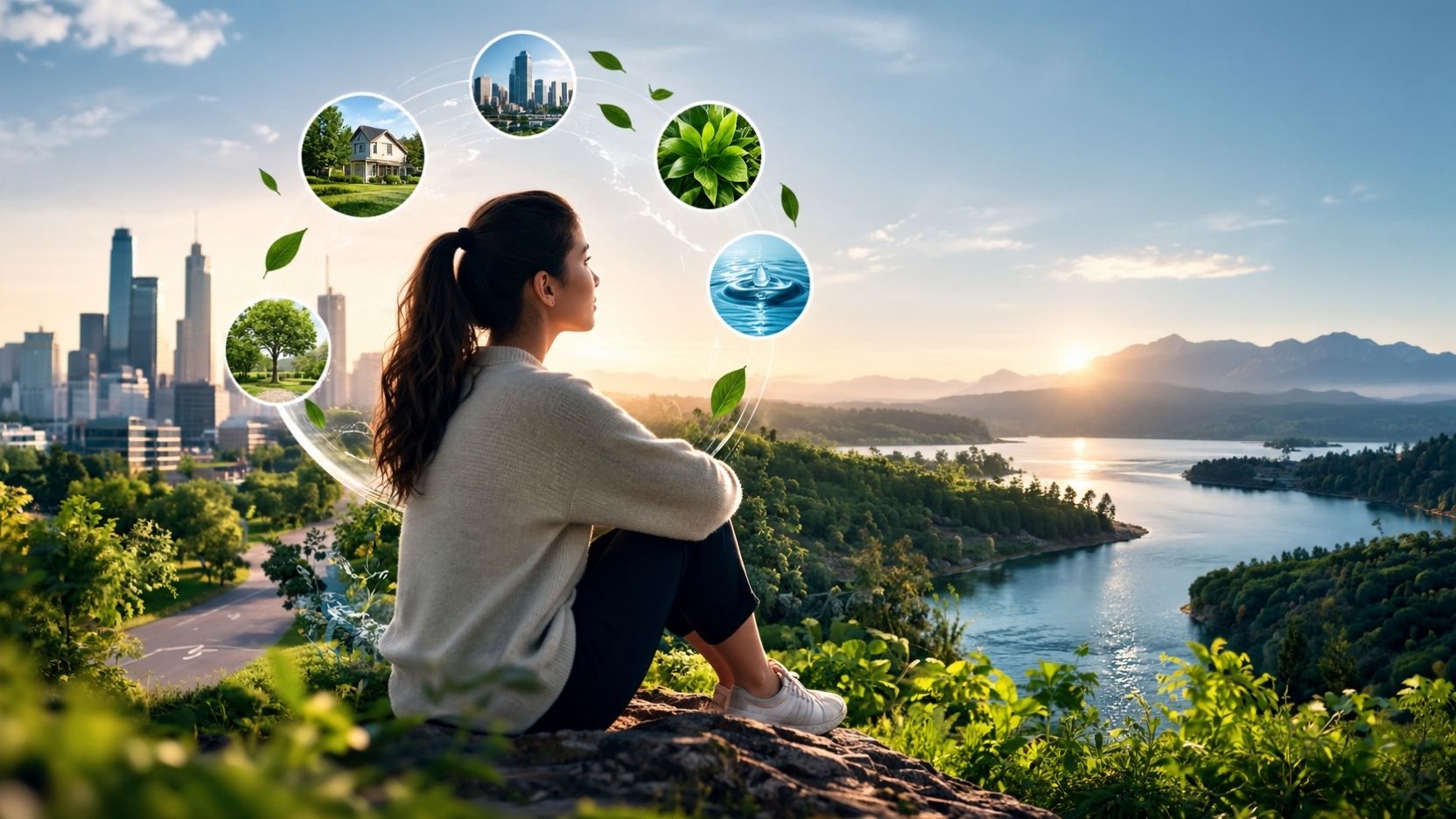
Environmental wellness is the part of your overall health that depends on your surroundings and your relationship with them. It covers the quality of your home, workplace, and community. It also covers how your daily choices affect nature. In short, it means living in a healthy, safe place while helping keep that place healthy for others.
This guide explains the definition, the reasons it matters, real examples, and steps you can take this week.
What Does Environmental Wellness Actually Mean?
Most people hear “environment” and think of forests, oceans, and climate change. Those matter. But environmental wellness starts closer to home.
It includes the air in your bedroom, the noise on your street, and the light in your office. It also includes whether you can walk safely in your neighborhood and whether you have access to clean water. Then it extends outward to the planet.
The idea works in two directions:
- Your environment affects you. Clean air, safe streets, green spaces, and calm spaces support your body and mind.
- You affect your environment. What you buy, waste, burn, and protect shapes the places you and others live in.
Environmental wellness is the habit of paying attention to both directions. You notice how your surroundings make you feel. You also take responsibility for what you add to them.
How Do Major Health Organizations Define It?
The most common definition in the United States comes from the Substance Abuse and Mental Health Services Administration, known as SAMHSA. SAMHSA describes the environmental dimension as occupying pleasant, healthy, and safe environments that support wellbeing, while also improving the quality of our surroundings, including protecting and preserving nature.
That definition has two parts. The first is about where you spend your time. The second is about what you do for that place.
Other organizations phrase it differently. One university wellness program frames it as accepting responsibility for preserving and sustaining the environment while recognizing the link between nature and health. A health institute summarizes the dimension as being in a nurturing, healthy environment and having awareness and respect for the environment around us.
The wording changes, but the core stays the same. Healthy surroundings and personal responsibility go together.
Is Environmental Wellness the Same as Environmental Health?
The two terms overlap, but they are not identical. Environmental health is a public health field. It studies how air, water, food, chemicals, and built spaces affect human health at the population level.
Environmental wellness is a personal and lifestyle concept. It asks what you can do, notice, and change in your own life and community.
| Feature | Environmental Health | Environmental Wellness |
| Main focus | Population level health risks from the environment | Personal habits and relationship with surroundings |
| Who leads it | Public health agencies, scientists, regulators | Individuals, families, schools, workplaces |
| Typical topics | Water safety, air quality standards, toxic exposure | Time in nature, recycling, healthy home spaces |
| Goal | Reduce environmental threats to health | Build a healthier, more mindful life within an environment |
Think of environmental health as the system and environmental wellness as your part in it. Strong public protections make personal wellness easier. Personal choices, in turn, add up to community change.
See More: Occupational Wellness Definition
Where Did the Idea of Environmental Wellness Come From?
Environmental wellness grew out of the broader wellness movement. The best known early framework came from Bill Hettler, a cofounder of the National Wellness Institute (NWI). Hettler created a six dimension model in 1976 to show how different parts of life connect to create a whole sense of wellness.
Here is where sources disagree, and it is worth knowing. The National Wellness Institute’s own current page lists six dimensions: emotional, occupational, physical, social, intellectual, and spiritual. Environmental is not on that list. Some other publications describe the environmental dimension as part of Hettler’s original model or as a later addition.
I could not confirm a single clear account of when the environmental dimension was formally added. What is clear is that many later models include it. SAMHSA’s eight dimensions are emotional, spiritual, intellectual, physical, environmental, financial, occupational, and social.
So if you are studying this for a class, check which model your course uses. The six dimension model and the eight dimension model are both common, and only some versions name the environmental dimension.
How Does Environmental Wellness Fit With the Other Dimensions?
Wellness models treat each dimension as connected to the others. Applying the model helps a person see how each dimension connects to the rest and contributes to healthy living.
Environmental wellness shows this clearly. A noisy, unsafe neighborhood can raise stress, which hurts emotional and physical wellness. A cluttered, dim workspace can drain focus, which affects occupational wellness. A shared community garden can improve physical, social, and environmental wellness at once.
Here is a quick comparison of the eight SAMHSA dimensions.
| Dimension | Core Idea | Environmental Connection |
| Emotional | Coping with life and handling feelings | Calm spaces and nature lower daily stress |
| Environmental | Healthy surroundings and stewardship | The dimension itself |
| Financial | Satisfaction with current and future finances | Energy saving and less waste often cut costs |
| Intellectual | Creativity and lifelong learning | Learning about ecology, gardening, or sustainability |
| Occupational | Fulfillment from work | Safe, comfortable, well designed workplaces |
| Physical | Activity, nutrition, sleep | Walkable areas, clean air, outdoor exercise |
| Social | Connection and belonging | Shared parks, cleanups, community projects |
| Spiritual | Purpose and meaning | Reflection and awe in natural settings |
What Is Occupational Wellness, and How Does It Relate?
Occupational wellness is about finding fulfillment and enrichment in your work or responsibilities. SAMHSA describes it as personal fulfillment and enrichment from one’s work and other responsibilities.
The link to environmental wellness is practical. Your workplace is an environment. Lighting, air quality, noise, ergonomics, and safety all shape how you feel at work.
Occupational wellness also has a stewardship side. Employers can reduce waste, offer recycling, and support green commuting. Employees can use shared resources thoughtfully. Many people feel more engaged when their workplace reflects values they care about.
What Is Social Wellness, and How Does It Relate?
Social wellness is about connection. SAMHSA frames it as a sense of connectedness and belonging.
Environmental wellness often builds social wellness. A neighborhood cleanup, a community garden, a group hike, or a tree planting day brings people together around a shared goal. These activities also make shared spaces better for everyone.
The relationship runs the other way too. People who feel connected to a community are more likely to care for its parks, streets, and buildings.
Why Is Environmental Wellness Important?
This is the question most readers have after the definition. The answer has several layers, and some are better supported by research than others.
Your Surroundings Shape How You Feel Every Day
You do not need a research study to notice this. A tidy, bright room feels different from a cluttered, dark one. A quiet street feels different from a loud highway. A park bench feels different from a parking lot.
Small environmental factors act on you all day long. They influence sleep, mood, focus, and stress. Because many people spend most of their time indoors, the quality of indoor spaces matters more than we tend to assume.
Time in Nature Is Linked to Better Health
One of the clearest findings in this area comes from a large study led by the University of Exeter. Researchers surveyed 19,806 adults in England about time spent in natural settings such as fields and woodlands, along with their self reported health and wellbeing.
The results were specific. People who spent at least 120 minutes a week in nature were significantly more likely to report good health and higher psychological wellbeing than those who had no nature contact. It did not matter whether the 120 minutes came in one long visit or several shorter ones.
There are limits worth stating plainly. Spending less than 120 minutes a week was not associated with improved wellbeing, and spending 200 to 300 minutes showed no additional benefit. The study also relied on self reports and found an association, not proof of cause. The authors themselves called for follow up studies.
Still, it offers a practical target. Two hours a week is achievable for most people.
Safe, Clean Surroundings Protect Physical Health
SAMHSA lists several factors that affect environmental wellness. These include pollution, violence, garbage buildup, and water conservation.
Notice that violence appears alongside pollution. Environmental wellness is not only about nature. It also covers whether a place feels safe and cared for.
This is also where equity matters. Not everyone has the same access to clean air, green space, or safe neighborhoods. Environmental wellness is easier for some people than others, and that is a fair point to keep in mind.
Caring for the Planet Supports Your Sense of Purpose
Many people find meaning in leaving things better than they found them. Environmental stewardship can give a sense of contribution that goes beyond personal comfort.
That sense of purpose connects to emotional and spiritual wellness. It can also reduce the helpless feeling some people have about large problems like climate change. Small, steady actions give you something concrete to do.
Everyday Choices Can Save Money
Environmental habits often overlap with financial wellness. Using less energy lowers utility bills. Wasting less food saves grocery money. Repairing items and buying secondhand costs less than buying new.
Not every green choice is cheaper. Some products cost more upfront. But many of the most effective habits, such as turning off lights and avoiding waste, cost nothing.
What Are the Signs of Strong Environmental Wellness?
Students often search for “what is an indication of environmental wellness” because it appears on quizzes and study sets. The question is usually multiple choice. The right answer is typically the option that shows awareness of or care for the surroundings.
Here are common indications:
- You spend regular time outdoors and enjoy it.
- You recycle, reduce waste, or compost where you can.
- You conserve water and energy at home.
- You keep your living and working spaces clean, safe, and comfortable.
- You notice how places affect your mood and adjust them.
- You take part in community efforts to improve shared spaces.
- You make purchasing choices with some thought about their impact.
- You respect wildlife, parks, and public property.
You do not need to do all of these. Environmental wellness is a spectrum, not a pass or fail test.
What Is the Primary Goal of Environmental Wellness?
The main goal is to live in harmony with your surroundings. In practice, that means two things happen together. You occupy places that support your health, and you take responsibility for protecting those places.
If a quiz asks for the primary goal, look for an answer that mentions both sides: healthy surroundings and responsibility toward the environment. Wording varies by textbook and instructor, so match your course materials.
What Is the Environmental Sphere of Wellness?
Some courses use the phrase “environmental sphere” or “environmental dimension.” They mean the same area of life. It is the part of wellness concerned with the physical and natural world around you, including homes, workplaces, communities, and nature.
See More: Environmental Wellness Examples
What Are Some Real Examples of Environmental Wellness?
Examples make the idea concrete. Here are practical ones grouped by where they happen.
At Home
- Opening windows to let fresh air circulate
- Keeping the bedroom dark, quiet, and cool for better sleep
- Using a reusable water bottle and grocery bags
- Switching to LED bulbs and turning off unused lights
- Fixing leaks and using less water
- Sorting recycling and composting food scraps
- Adding houseplants for greenery
At Work or School
- Setting up a comfortable, well lit workspace
- Taking breaks outside when possible
- Printing less and using shared digital files
- Using a reusable mug and lunch containers
- Joining a green team or campus sustainability group
- Walking, biking, or using public transit when it is practical
In Your Community
- Joining a neighborhood cleanup
- Volunteering at a community garden
- Supporting local farmers markets
- Reporting hazards like illegal dumping
- Taking part in tree planting events
- Advocating for safer streets and more green space
In Nature
- Walking in a local park or along a trail
- Hiking, camping, or kayaking
- Gardening in a yard, balcony, or windowsill
- Birdwatching
- Following Leave No Trace principles outdoors
- Picking up litter when you spot it
SAMHSA gives its own examples. It suggests starting a neighborhood watch, recycling, planting a personal or community garden, buying products with minimal packaging, avoiding littering, and saving energy and water by turning off lights and taps when not in use.
What Are Good Environmental Wellness Activities?
Activities work best when they are easy to repeat. Here are ideas sorted by effort.
Quick Activities (Under 15 Minutes)
- Step outside and take a short walk after lunch.
- Open a window and air out a room.
- Unplug chargers and devices you are not using.
- Water or rearrange your plants.
- Declutter one drawer or shelf.
- Sort the recycling bin properly.
Weekly Activities
- Spend a longer block in a park, trail, or green space.
- Plan meals to reduce food waste.
- Walk or bike for one errand instead of driving.
- Tidy and deep clean one area of your home.
- Visit a farmers market.
- Do a short litter pickup on your street.
Bigger Projects
- Start a small vegetable or herb garden.
- Set up a home compost system.
- Do a home energy check and fix drafts.
- Organize a neighborhood cleanup.
- Volunteer regularly with a local environmental group.
- Plan a camping or nature trip with friends or family.
Activities for Kids and Families
- Plant seeds and track their growth
- Make a backyard or balcony bird feeder
- Go on a nature scavenger hunt
- Build a family recycling routine
- Visit a national, state, or local park together
Children often pick up environmental habits by watching adults. Making these activities playful helps them stick.
How Can You Improve Environmental Wellness Step by Step?
Trying to change everything at once usually fails. A gradual plan works better. Here is a simple approach.
- Take a quick inventory. Walk through your home, workplace, and neighborhood. Note what feels good and what feels draining. Look at air, light, noise, clutter, safety, and access to nature.
- Pick one problem and one habit. Choose a single issue to fix, like a dark bedroom. Choose a single habit to build, like a daily walk.
- Start with what is free. Turn off lights, reduce waste, and spend time outside. These cost nothing.
- Aim for two hours in nature each week. Break it into short visits if needed. The Exeter study suggests this is a useful target.
- Make your space calmer. Reduce clutter, improve lighting, and add a plant or natural light source.
- Add one community action. Join a cleanup, garden, or local group once a month.
- Review after a month. Keep what works. Drop what does not. Add one new habit.
This approach respects an important truth. Consistency beats intensity. A small habit you keep for a year does more than a dramatic change you abandon in two weeks.
A Simple Thirty Day Starter Plan
| Week | Focus | Sample Actions |
| Week 1 | Awareness | Audit your spaces, note what feels good or draining |
| Week 2 | Home habits | Cut energy waste, sort recycling, refresh one room |
| Week 3 | Nature time | Reach about two hours outside across the week |
| Week 4 | Community | Join one local activity or volunteer session |
What If You Face Real Obstacles?
Environmental wellness advice can sound easy when you have a yard, a car, and extra money. Many people do not. Here are common barriers and realistic responses.
What If You Rent or Cannot Change Your Space?
You still have options. Add plants, adjust lighting with lamps, use curtains to control light, and keep spaces clean and tidy. Portable items like air purifiers or fans can help. Talk to your landlord about repairs like leaks or mold.
What If You Live in a City With Little Green Space?
Look for small pockets of nature. Many cities have pocket parks, community gardens, river paths, and tree lined streets. A windowsill herb garden counts. So does watching the sky or noticing trees on your commute.
What If You Have Limited Time or Energy?
Start tiny. Two minutes outside is better than none. Pair habits with things you already do. Drink your morning coffee on a porch or by an open window. Walk during a phone call.
Some people also face health or mobility limits. Environmental wellness can include sitting by a window with a view, listening to nature sounds, or tending indoor plants.
What If Green Products Are Too Expensive?
Skip the products and focus on behavior. Use what you already own. Repair, reuse, and borrow. Buy secondhand. Reduce waste first, since that is usually free.
What If Climate News Makes You Feel Helpless?
This is a common reaction. Large environmental problems cannot be solved by one person. But small actions can still matter, and community action helps most.
Limit constant doom scrolling. Focus on actions within your reach. If anxiety feels heavy or constant, consider talking with a mental health professional.
Is Environmental Wellness Just Another Word for Being Eco Friendly?
Not exactly. Being environmentally friendly focuses mainly on what you do for the planet. Environmental wellness also includes how your surroundings affect your own health.
A person can recycle perfectly and still live in a stressful, unhealthy space. Another person can have a calm, healthy home but never think about waste. Environmental wellness asks you to look after both.
It is also not about perfection. You do not have to adopt a zero waste lifestyle or give up your car to practice it. The goal is steady, thoughtful improvement.
Quick Study Guide for Students
Many readers search for this topic for health classes. Here is a short summary of what instructors commonly ask. Always check your own textbook, since answers can vary.
| Question | Typical Answer |
| What is environmental wellness? | Living in healthy, safe surroundings and protecting the environment |
| Which organization lists it as one of eight dimensions? | SAMHSA |
| Name one example | Recycling, gardening, conserving water, spending time in nature |
| What is a main goal? | Healthy surroundings plus responsibility for the environment |
| How does it connect to other dimensions? | It affects physical, emotional, social, financial, and occupational wellness |
If you want a printable version, many universities and health agencies publish wellness handouts you can search for. Make sure the source is reputable and matches your course.
What Should You Take Away From All This?
Environmental wellness is about two things working together: living in surroundings that support your health, and caring for those surroundings in return.
It starts small. Notice how your spaces make you feel. Spend about two hours a week outside. Cut waste where you can. Join something in your community. Build habits you can keep.
You do not need perfect conditions or a big budget. You need attention, consistency, and a willingness to improve one thing at a time. Pick one action from this guide and try it this week.
See More: Wellness Goals
Frequently Asked Questions
What is environmental wellness in simple terms?
It means living in healthy, safe surroundings and taking care of the environment. It covers your home, workplace, community, and nature. Your surroundings affect your health, and your actions affect your surroundings.
What is the definition of environmental wellness?
SAMHSA defines it as occupying pleasant, healthy, and safe environments that support wellbeing, while improving the quality of your surroundings. That includes protecting and preserving nature. Other organizations use similar wording.
Why is environmental wellness important for health?
Your surroundings influence stress, sleep, mood, and physical health. Safe, clean, calm spaces support you. Research also links regular time in nature with better self reported health and wellbeing.
What are examples of environmental wellness?
Examples include recycling, conserving water and energy, gardening, walking in parks, and keeping your home clean and safe. Joining a neighborhood cleanup or community garden also counts.
What is an indication of environmental wellness?
Signs include respecting nature, reducing waste, spending time outdoors, and keeping your spaces healthy. Taking part in community efforts to improve shared places is another sign.
What is a primary goal of environmental wellness?
The goal is to live in harmony with your surroundings. That means occupying healthy places and taking responsibility for protecting them. Exact wording can vary by course or textbook.
How can I improve environmental wellness quickly?
Start with free habits. Spend time outside, open windows, turn off unused lights, and reduce waste. Pick one small change and repeat it daily or weekly until it feels natural.
How much time in nature is enough?
One large study of about 20,000 adults in England linked at least 120 minutes a week with better reported health and wellbeing. The time could be one visit or several. It shows an association, not proof of cause.
What is occupational wellness?
It is the personal fulfillment and enrichment you get from your work or responsibilities. It connects to environmental wellness through workplace safety, comfort, and sustainability practices.
What is social wellness?
Social wellness is a sense of connectedness and belonging. It involves healthy relationships and community ties. Group environmental activities, like cleanups and gardens, can strengthen it.
Is environmental wellness part of the eight dimensions of wellness?
Yes. SAMHSA’s eight dimensions include environmental wellness alongside emotional, spiritual, intellectual, physical, financial, occupational, and social wellness. Some other models use six dimensions and may not list it.
Can you practice environmental wellness without a yard or much money?
Yes. Use windowsill plants, visit public parks, reduce waste, conserve energy, and buy secondhand. Many of the most effective habits are free.