
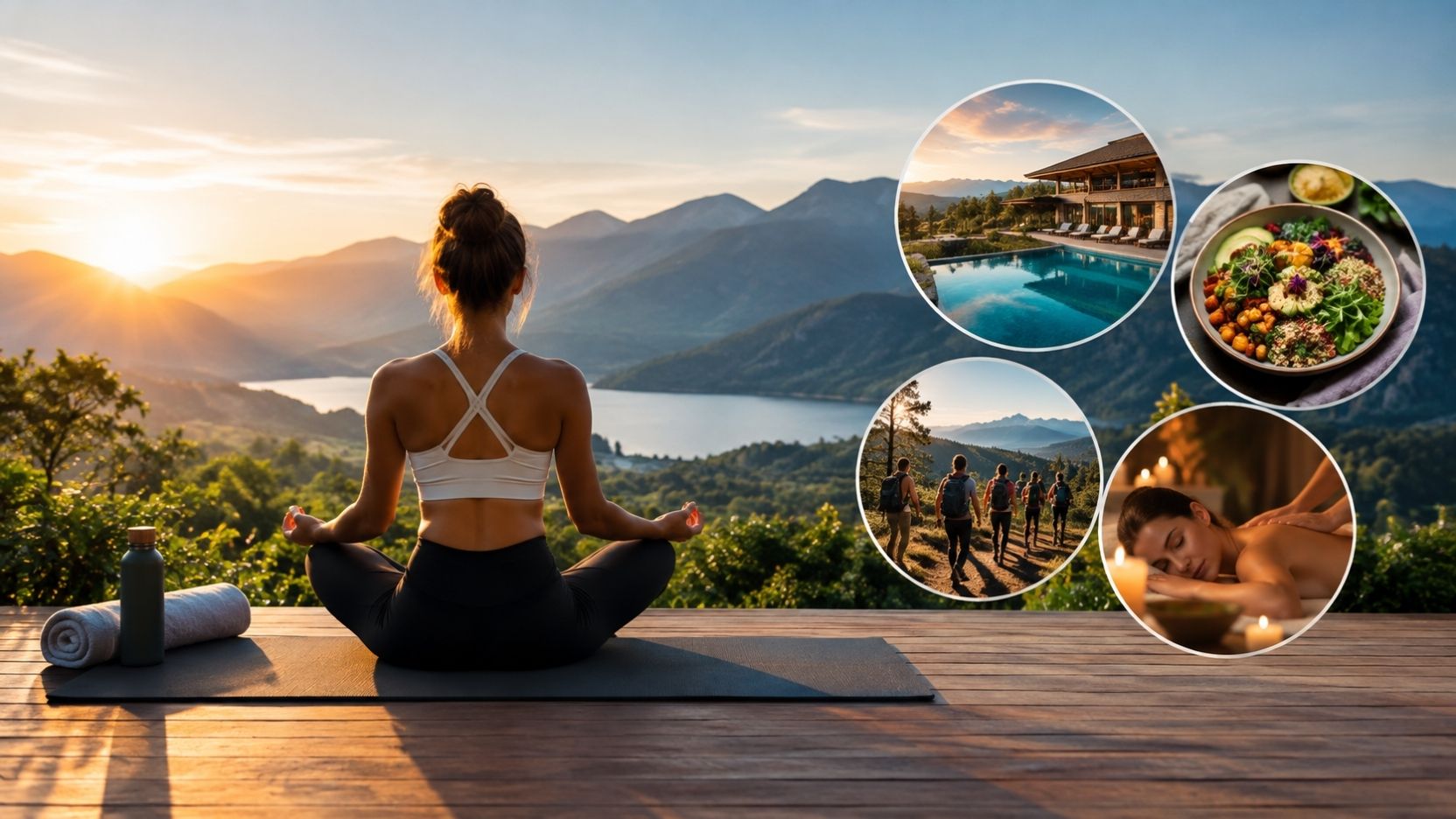
A wellness retreat in the USA is a stay, usually three to seven days, built around structured programming rather than free time. You get scheduled yoga, guided meditation, healthy meals, and often spa treatments or one on one coaching. Prices span an enormous range, from around 80 dollars a night at a simple ashram to more than 1,000 dollars a night at a destination spa like Canyon Ranch or Miraval.
That range is exactly why so many people get stuck at the research stage. “Wellness retreat” gets used for a weekend yoga intensive in a state park cabin and for a medically supervised longevity program with a private physician. Both are real. They are just not the same purchase.
This guide walks through what these retreats actually include, what they cost at each tier, and how to match a retreat to what you are actually trying to fix, whether that is burnout, a relationship that needs attention, or a body that needs rest.
What Counts as a Wellness Retreat in the USA Right Now
The category has grown past the classic image of a silent yoga studio. Today it generally falls into a few recognizable types, and knowing which one you are looking at will save you a lot of scrolling.
Destination spas are full resorts built entirely around wellness, with daily fitness classes, spa treatments, and nutrition programming included in the nightly rate. Canyon Ranch and Miraval are the two names that come up most often here.
Yoga and meditation retreats are smaller, often centered on one teacher or tradition, and run anywhere from a weekend to several weeks. They tend to be the most affordable format.
Mental health and trauma focused retreats bring licensed therapists into the program and often use modalities like EMDR, somatic work, or group therapy alongside the usual yoga and nature time.
Corporate wellness retreats are built for teams, usually mixing workshops on stress and communication with structured downtime, and are booked by a company rather than an individual.
Adventure and fitness retreats pair hiking, strength training, or climbing with recovery focused evenings, popular in places like Utah, Colorado, and Sedona.
Knowing which bucket you are shopping in matters more than the specific keyword you searched. A person typing “affordable wellness retreats USA” and a person typing “mental health wellness retreats USA” are usually solving two different problems.
See More: Holistic Wellness Activities
What a Typical Day Actually Involves
Programming varies by retreat, but most multi day wellness retreats in the USA follow a similar rhythm:
- An early morning session, usually yoga, breathwork, or a guided walk
- A nutrient dense breakfast, often vegetarian or plant forward
- A midday workshop, lecture, or skills session (nutrition, stress management, sleep)
- Free time or a spa treatment slot in the early afternoon
- An afternoon movement class or hike
- A communal dinner
- An evening wind down activity, such as a sound bath, journaling circle, or fireside talk
Higher end resorts add medical consultations, body composition testing, or private coaching sessions. Smaller retreat centers replace some of this with communal chores, silent meals, or group therapy circles, depending on the theme.
How Much Does a Wellness Retreat in the USA Cost
Cost is the single biggest source of confusion in this category, mostly because “retreat” describes a $150 a night yoga weekend and an $8,000 a week destination spa program equally well. Here is a realistic breakdown by tier.
| Retreat Type | Typical Price Range | Length | What Is Usually Included |
| Budget or donation based | 60 to 200 dollars per night | 2 to 7 days | Shared room, simple vegetarian meals, group classes |
| Mid range all inclusive | 200 to 800 dollars per night | 3 to 5 days | Private or shared room, all meals, daily classes, one or two treatments |
| Luxury destination spa | 800 to 2,000+ dollars per night | 3 to 7 days | Private suite, all meals, unlimited classes, daily spa credit, health consultations |
| Intensive mental health retreat | 3,000 to 20,000 dollars total | 4 to 10 days | Private therapy sessions, small group size, luxury accommodation, clinical staff |
| Corporate group retreat | Custom, often 1,500 to 4,000 dollars per person | 2 to 4 days | Meeting space, team workshops, meals, activities |
A few things worth knowing before you compare prices across sites. All inclusive almost always means meals and scheduled classes are covered, but specialty treatments, private therapy add ons, and alcohol are often extra. Shoulder season, meaning spring and fall, tends to run noticeably cheaper than summer or the winter holiday window. Shared rooms can cut the nightly rate substantially compared to a private single.
Affordable and All Inclusive Wellness Retreats Worth Considering
You do not need a five figure budget to get a genuine reset. Several established, well reviewed options sit well under 1,000 dollars for a multi night stay.
The Sivananda Ashram Yoga Ranch in New York offers a shared room and daily yoga, meditation, and vegetarian meals for roughly 80 to 110 dollars per person per night, with a camping option that runs even lower. It is one of the longest running affordable retreat centers in the country.
Healing Waters Resort and Spa in Pagosa Springs, Colorado, centers on naturally heated soaking pools rather than a packed class schedule, with rooms starting around 80 dollars a night, particularly good value in the fall and spring.
Marketplaces like BookRetreats and Retreat Guru list dozens of shorter, host led options across the country, many in the 600 to 2,000 dollar range for a long weekend that includes lodging, meals, and workshops. Prices climb with group size, private accommodation, and how remote or scenic the setting is.
A note on the phrase “affordable all inclusive.” In practice, this usually means a smaller retreat center or a shared cabin format rather than a full service resort. You trade some polish and privacy for a much lower price, which is a completely reasonable trade for a first retreat or a solo traveler on a budget.
Quick Comparison of Budget Friendly Options
| Retreat or Center | Location | Typical Starting Price | Best For |
| Sivananda Ashram Yoga Ranch | Woodbourne, New York | About 80 to 110 dollars per night | First time retreat goers, yoga focus |
| Healing Waters Resort and Spa | Pagosa Springs, Colorado | About 80 dollars per night | Soaking, low key relaxation |
| Weekend host led retreats (BookRetreats, Retreat Guru) | Various states | 600 to 2,000 dollars for 3 to 5 days | Themed experiences, small groups |
Luxury Wellness Retreats: Canyon Ranch, Miraval, and the Names Everyone Recognizes
At the other end of the market sit a handful of destination spas that essentially built the modern American wellness retreat category.
Canyon Ranch has locations in Tucson, Arizona, and Lenox, Massachusetts. Founded in 1979, it built its reputation on integrative medicine consultations, behavioral health sessions, and a genuinely broad class schedule rather than pure pampering. Rates at the Lenox property start around 950 dollars per person per night, all inclusive of meals and most programming, and a full week at the Tucson property can run into several thousand dollars depending on room type and season.
Miraval Arizona, also in Tucson, is adults only and built around its no phones in public spaces policy. Rates start around 569 dollars per person per night in summer and climb toward 1,700 dollars in peak season, with meals, more than 100 included activities, and airport transfers bundled in. Miraval also has sister properties in the Berkshires and near San Diego.
Lake Austin Spa Resort in Texas offers lakeside cottages, an aquatic focused spa, and an all inclusive rate starting around 2,000 dollars a night for double occupancy, positioning it as one of the more romantic, couples friendly luxury options.
The Ranch Malibu in California takes a different approach, built around a demanding fitness and nutrition program that guests repeat for one to four weeks at a time, and is popular with people who want measurable physical results rather than pure relaxation.
Sensei Lanai, a Four Seasons property in Hawaii, blends body composition analysis and personalized wellness planning with Nobu designed dining, representing the higher end of what a technology assisted, data driven retreat looks like.
None of these are marketed as inexpensive, and they should not be mistaken for it. What you are paying for is consistency: a trained clinical or wellness staff, a genuinely varied schedule, and infrastructure that a small retreat center simply cannot replicate.
Wellness Spa Retreats vs. Yoga Retreats: Knowing the Difference
Two terms get used almost interchangeably in search, and they describe genuinely different trips. A wellness spa retreat centers on treatments: massage, hydrotherapy, facials, and body work, usually inside a full service resort with a large spa facility. The daily schedule is lighter, and guests often build their own itinerary around a handful of booked treatments rather than following a fixed group timetable.
A yoga or meditation retreat, by contrast, is built around a group schedule of classes led by one or two teachers, with meals and lodging designed to support that practice rather than to showcase spa infrastructure. These tend to be smaller, less expensive, and more communal.
Neither is objectively better. Someone who wants to be pampered and left alone in the afternoons usually prefers a spa retreat. Someone who wants structure, a teacher, and a group experience usually prefers a yoga retreat. Reading the sample daily schedule on a retreat’s booking page, rather than the word “wellness” in the title, is the fastest way to tell which one you are actually looking at.
See More: Synergy Nutrition And Wellness
Niche and Specialty Wellness Retreats Worth Knowing About
Beyond the mainstream categories, a few more specific formats have grown a dedicated following in the USA.
Alpine and mountain wellness retreats lean on elevation, cooler air, and access to hiking or skiing as part of the program itself, not just scenery. Colorado’s mountain towns and parts of Utah are the main hubs, and these retreats often combine altitude focused breathwork with more conventional fitness and recovery programming. Expect a moderate fitness level to be genuinely useful, since many include daily hikes rather than purely gentle movement.
Art centric wellness retreats fold creative practice, painting, pottery, writing, or music, into the daily schedule alongside yoga and meditation, on the theory that creative flow states offer a similar stress reducing effect to mindfulness practice. These tend to attract people who find traditional meditation difficult to sit with but respond well to a more active, expressive form of reflection.
Personalized or concierge style retreats are built around a single guest or a small private group rather than a fixed cohort, with the daily schedule built from an intake conversation rather than chosen off a menu. These cost more per person than a group retreat of similar length, but they remove the mismatch risk of ending up in a group whose pace or focus does not suit you.
Longevity and biohacking retreats, an increasingly visible trend at the higher end of the market, add lab testing, wearable data tracking, and physician consultations to the usual wellness programming, aiming at long term health metrics rather than a single week’s relaxation. These are generally the most expensive format outside of intensive clinical mental health retreats.
Best Wellness Retreats for Couples
Couples retreats generally fall into two camps: resort style destination spas with couples treatments bolted on, and smaller retreats specifically designed around relationship work.
For a resort style option, Lake Austin Spa Resort and Miraval Arizona both offer couples spa suites, side by side treatments, and enough structured activity to keep two people with different energy levels both occupied. The Lodge at Woodloch in Pennsylvania is a smaller scale alternative with a strong spa program and forest surroundings, popular for a shorter, less expensive couples getaway.
For couples who want the retreat to actively address the relationship rather than just relax together, smaller host led retreats, often found through Retreat Guru or BookRetreats, build in guided communication exercises, couples massage, and evening reflection time. These tend to run from around 3,000 to 5,000 dollars for a long weekend and are worth it specifically for people who want structured time to reconnect, not simply a nicer version of a normal vacation.
Solo and Women’s Wellness Retreats: What to Know Before You Book Alone
Solo attendance is now one of the biggest drivers of the entire category, and women specifically make up a large share of that growth. Wellness tourism overall has been valued at hundreds of billions of dollars globally, and solo, women focused retreats are one of the fastest growing segments within it.
Before booking a solo retreat, it helps to get clear on what you actually want, since “solo wellness retreat” covers very different experiences:
- A full digital detox, with no phone signal and no fixed schedule, for people who want true disconnection
- Structured programming, with a set daily itinerary and expert led sessions, for people who want guidance rather than open time
- A women’s only group setting, which many first time solo travelers find easier and safer than a mixed group or a fully unstructured trip
- A specific life transition focus, such as divorce, grief, burnout, or a career change
- A low commitment single day or weekend option, ideal for testing whether retreat style travel suits you before committing to a longer, pricier stay
Sedona, Arizona, comes up constantly in this search because of its concentration of women’s retreats, ranging from a 2 day, 850 dollar solo retreat to multi day programs well above 4,000 dollars. Before booking, look for hosts who do a short intake call beforehand to confirm dietary needs, physical limitations, and goals, since that step is a reasonable proxy for how organized the rest of the retreat will be.
Mental Health Focused Wellness Retreats: What They Actually Offer
Mental health retreats sit in a different category from a spa vacation, and the distinction matters both for expectations and for cost. These programs typically bring in licensed therapists and use evidence based approaches such as EMDR, somatic experiencing, or structured group therapy, layered over the usual yoga, nutrition, and nature components.
They are generally aimed at people managing anxiety, depression, burnout, or trauma who want more intensity than weekly outpatient therapy but do not need inpatient psychiatric care. Programs like this can run anywhere from a few hundred dollars for a single trauma informed workshop day to 15,000 to 20,000 dollars for a private, multi day retreat with one on one clinical sessions and luxury accommodation.
A note on insurance. Coverage for these retreats is inconsistent and depends heavily on your specific plan, whether the retreat is affiliated with a licensed clinical provider, and whether the services delivered qualify as billable therapy under your policy. Most standalone wellness retreats, even ones with therapists on staff, are not treated as covered medical care by insurers. If cost or coverage is a deciding factor, call your insurer directly before booking and ask specifically whether the named provider or facility is in network, rather than relying on how the retreat markets itself.
If you are in crisis or experiencing suicidal thoughts, a wellness retreat is not an appropriate substitute for emergency or inpatient psychiatric care. The 988 Suicide and Crisis Lifeline is available by call or text at any time.
Corporate Wellness Retreats: Why Companies Are Booking Them
Team offsites have shifted noticeably away from generic conference rooms toward structured wellness programming, with leaders citing burnout and constant digital noise as the problems they are actually trying to solve. A useful way to think about planning one is around four variables: location, schedule, food, and how the lessons transfer back to the office once everyone goes home.
Popular settings include Sedona for its scenery and access to local practitioners, Colorado’s mountain towns for altitude and outdoor activity, and Arizona or Florida for reliable weather. The best run corporate retreats balance structured workshops with genuine unscheduled time, since a fully packed itinerary tends to undercut the actual goal of letting people recover rather than just relocate their stress.
Where Most of the Best Wellness Retreats in the USA Are Located
Geography shapes the style of retreat you will find in a given region almost as much as budget does.
Arizona, particularly Tucson and Sedona, is the closest thing the USA has to a wellness capital. The dry desert climate, red rock scenery, and long established infrastructure around Canyon Ranch and Miraval have made it the default choice for both luxury destination spas and smaller, women focused or spiritually oriented retreats.
The Northeast, especially the Berkshires in Massachusetts and the Pocono region of Pennsylvania, favors a quieter, forest based style of retreat, with Canyon Ranch Lenox and The Lodge at Woodloch as anchor properties. Expect a more seasonal experience, with autumn foliage and winter snow sports adding variety that desert locations cannot offer.
California, from Napa Valley to the coast, tends toward a food and culture forward version of wellness, pairing spa treatments with farm to table dining and, in some cases, wine country settings that sit slightly outside the traditional health retreat mold.
The Pacific Northwest, including parts of Oregon and Washington, is where most of the country’s forest bathing and digital detox retreats cluster, taking advantage of dense old growth forest and a strong existing culture of outdoor mindfulness practice.
Colorado and Utah lead on adventure and altitude focused retreats, combining hiking, climbing, and mountain scenery with recovery focused evening programming, and are a strong fit for people who want physical challenge built into their reset rather than pure stillness.
Texas and Florida have grown quickly as wellness destinations too, with Lake Austin Spa Resort representing the luxury tier in Texas, and a wide range of beach based, women’s, and mental health focused retreats concentrated around Florida’s coastline.
None of these regions is objectively best. A desert setting suits someone who wants dry heat and stark scenery; a coastal Florida retreat suits someone who wants ocean access and a shorter flight from most of the East Coast. Matching climate and landscape to your own preferences is a small detail that has an outsized effect on how restorative the week actually feels.
What People Actually Ask Before Booking
Search behavior around this topic, including the volume of questions on forums and community sites, clusters around a few consistent worries rather than the marketing language retreats themselves use.
The most common one is simply whether it is worth the money. People who have written about their own experiences tend to describe measurable, if modest, benefits, like better sleep or lower stress, that persisted for weeks or months after returning home, particularly when the retreat matched a specific need rather than being a generic escape. The honest answer is that value depends heavily on matching the retreat’s actual focus to your actual problem, not on price alone.
The second most common concern is going alone, especially for women, which is why women’s only retreats and hosts who offer a pre retreat intake call tend to get repeat bookings.
The third is what is actually included, since “all inclusive” can mean very different things between a boutique resort and a small host led retreat. Reading the included list line by line, rather than the marketing headline, is the single best way to avoid a surprise bill.
How to Choose the Right Wellness Retreat for You
A few questions, answered honestly before you book, will narrow the field faster than any list of top rated retreats.
What problem are you actually trying to solve? Burnout, a relationship that needs attention, a body that needs rest, or a mental health concern that needs professional support all point toward different retreat types, not just different price points.
How much structure do you want? Some people recover best with a packed schedule and zero decisions to make. Others need unstructured time and space to think. Read the sample daily schedule before booking, not just the photos.
What is your real budget, including extras? Add 15 to 25 percent to the advertised rate to cover optional treatments, transportation, and gratuities, especially at destination spas where the nightly rate does not include everything.
Do you want company or solitude? A group retreat with shared meals suits people who want connection. A private, host led experience suits people who want to be left alone for most of the day.
Is the timing realistic? Shoulder season, generally April through May and September through October, tends to offer noticeably better pricing and smaller crowds than summer or major holidays.
See More: Wellness Triangle
Wellness Retreats in the USA: A Final Word
The right wellness retreat in the USA is less about finding the highest rated resort and more about matching format, cost, and focus to what you actually need right now. A burned out professional with three days off is solving a different problem than a couple trying to reconnect after a hard year, and both are solving a different problem than someone managing a specific mental health concern with professional support. Get clear on that first, and the rest of the decision, including budget, location, and length of stay, tends to sort itself out quickly.
Frequently Asked Questions
What is the average cost of a wellness retreat in the USA?
Costs vary widely, from about 80 dollars per night at a basic yoga ashram to more than 1,000 dollars per night at a luxury destination spa like Canyon Ranch or Miraval. Most mid range, all inclusive options fall between 200 and 800 dollars per night.
Are wellness retreats in the USA all inclusive?
Many are, but the term usually covers meals, lodging, and scheduled classes, not specialty spa treatments, alcohol, or private add on sessions. Always check the included list rather than assuming full coverage.
What is the best time of year to book a wellness retreat?
Spring and fall, often called shoulder season, generally offer lower prices and smaller groups than summer or major holiday periods, without sacrificing weather quality in most parts of the country.
Are wellness retreats covered by health insurance?
Rarely, and it depends on your specific plan and the retreat’s clinical affiliation. Standalone wellness retreats, even those with therapists on staff, are usually not billed as covered medical care. Confirm directly with your insurer before booking if this matters to you.
What should I pack for a wellness retreat?
Comfortable, layered clothing for movement classes, a swimsuit if the property has pools or hot springs, a journal, and any personal medications. Many retreats also encourage bringing minimal electronics.
Are wellness retreats safe for solo female travelers?
Reputable retreats, particularly women’s only programs, are generally considered a safer entry point into solo travel than an unstructured trip, especially those that offer a pre arrival intake call and a small, vetted group size.
What is the difference between a wellness retreat and a spa vacation?
A spa vacation is typically unstructured, with treatments booked à la carte. A wellness retreat has a set daily schedule of classes, workshops, and meals built around a specific wellness goal.
Can couples do a wellness retreat together?
Yes, and both destination spas like Miraval and Lake Austin, and smaller host led relationship focused retreats, offer couples specific programming, from side by side spa treatments to guided communication exercises.
How long should a first wellness retreat be?
A weekend or three night stay is a reasonable starting point for a first time retreat goer, long enough to notice a shift without requiring a major time or financial commitment.
Do wellness retreats help with anxiety and depression?
Retreats with licensed clinical staff and evidence based modalities can provide meaningful, intensive support, but they are generally positioned as a supplement to ongoing care, not a replacement for therapy or psychiatric treatment. If you are in crisis, contact a licensed provider or the 988 Suicide and Crisis Lifeline rather than relying on a retreat.
What is included in a corporate wellness retreat?
Typically meeting or workshop space, team building activities, meals, and structured downtime, priced per person and customized based on group size and goals.
Are affordable wellness retreats actually good quality?
Price does not always track with quality in this category. Long established, budget friendly centers like the Sivananda Ashram have decades of consistent programming, while some higher priced options are newer and less proven. Reviews and how long a center has operated matter more than the price tag alone.